
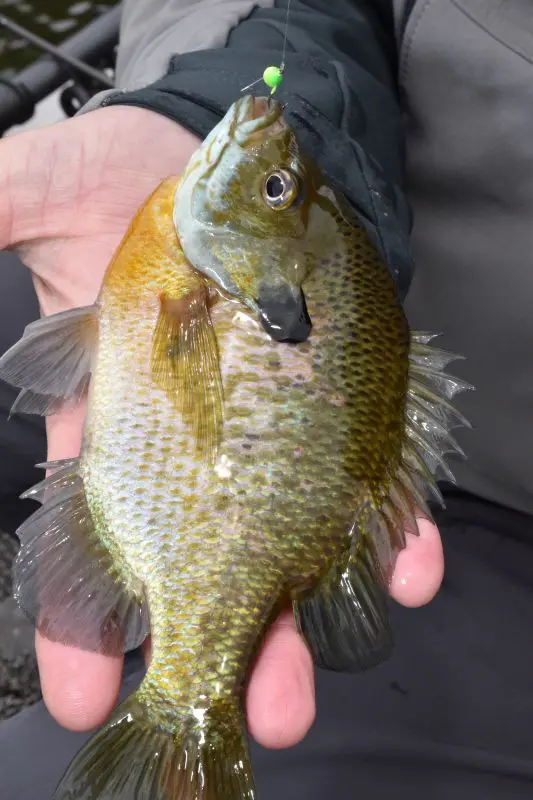
Anglers look forward to the spring panfish spawn. Panfish are in predictable places when they’re spawning. The timing varies depending on latitude and longitude, but it happens eventually. Anglers who wait until the spawn is underway are missing out big time. Pre-spawn panfish stage adjacent to bedding areas in deeper water long before they spawn. The fish are tightly schooled, so electronics are key to locating concentrations. Targeting pre-spawn panfish can give you a jump on the season while others wait for them to move shallow.
Perch are the first to spawn just after ice-out in the north. Jumbo yellow bellies infiltrate shallow, south-facing, dark-bottomed coves, channels, and bays when some of the lake still has ice. Crappies stage near structure. Stick-ups, docks, and bridge abutments that reflect spring sunshine draw specks before moving into the shallows. Crappies suspend, so slip-bobbers and FFS excel. Bluegills and sunfish spawn up to a month later than either perch or crappies, and may use the exact pre-spawn locations. Fish that will be in just a foot or two of water in May and June will be clustered, tightly schooled, and suspended at 10 to 20 feet or more, biding their time. Savvy anglers get the jump on them before they spawn.
For species like yellow perch, the spawning movement begins before the ice is even gone if you live in a northern climate. Perch will gradually move toward shallow water as soon as the ice starts to recede, if not sooner. The precocious male will begin seeking out shallow bays, followed by portly, egg-laden females. The perch can be found in as little as a couple of feet of water, especially if it’s a dark-bottomed, south-facing cove.
My friend Craig Petersen keeps close tabs on a local body of water, and as soon as he can drift a float, he’s there. Sometimes that is in March. Sometimes it’s in April. Usually, the bayou isn’t ice-free, and quite often he’s only fishing a small area of open water. Drifting a bobber with a waxworm, suspending a live minnow, or a Gulp! Minnow, if the bite is hot, Petersen will have several buckets of jumbo yellow bellies in the freezer before anyone even realizes there’s open water.
Forward-facing sonar isn’t much use in such shallow water. Your temperature gauge can be more valuable. Subtle changes of only a couple of degrees can concentrate panfish.
A couple of springs ago, I got on the lake in mid-March following a mid-winter. The main lake was still 35 degrees, but as I eased into the back of a shallow cove, I watched the thermometer on my graph climb to 39 degrees. Perch were clustered in the tepid water, and I had a field day. A few days later, after a brief cold spell, I went back, and the bayou had refrozen. I stopped under a bridge to try next to the bridge abutments. I reasoned that pre-spawn crappies might be staging there. The rising morning sun was beginning to shine on the concrete. I thought some crappies might be suspended, taking advantage of the warmth. The water was 11 feet deep next to the pilings, but I set my slip float 5 feet down.
The slender bobber plopped next to the abutment, quickly stood up, and slipped under ever so slightly. I snapped the rod tip of the 7-1/2-foot ultralight rod upward and hoisted a 6-inch crappie into the boat. “They’re here,” I told myself. The next cast produced a 10 incher. About every third fish, I had to stop and put my hands under my armpits to warm up. My fingers ached as they regained feeling. The rising sun belied the 26-degree air temperature.
Staying warm is half the battle in early spring. It may be colder than ice fishing because you’re not in a shelter. You need to dress like you’re sitting on the ice. I typically start the spring in my Whitewater Great Lakes Pro jacket and bibs. It’s the warmest apparel I’ve got. The poly/spandex 4-way stretch shell combined with the polyester lining allows me to stretch to net fish, deploy the anchor, or reach to open the live well. The DWR treatment on the jacket and bibs shields you from icy spray and wind. When combined with the windproof and waterproof/breathable 30k/30k lamination and taped seams, there’s no worry about staying dry regardless of the conditions.
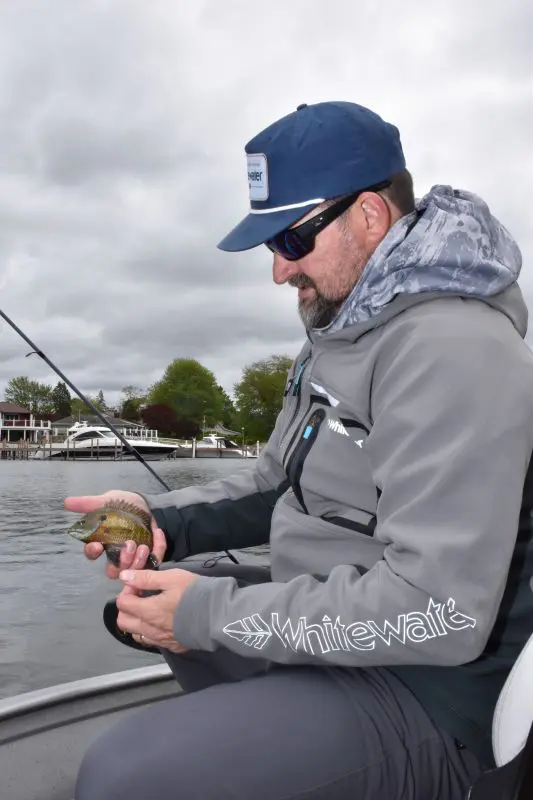
- Doug Veldhuizen with a decent spring bluegill.
Two essentials for fishing when the water is on the verge of freezing are headgear and gloves. I’m not a big fan of head-scratching beanies, but I relent, and in early spring I wear one. A warm, soft 100% acrylic rib knit beanie like Whitewater’s Knit Beanie protects the most vulnerable place for heat loss.
Goves are essential. You can’t function without them when the water is just barely liquid. The insulating properties of Merino wool are well documented. The 19.5-micron 60g merino wool fabric used in Whitewater’s new half-finger gloves is naturally moisture-wicking and antimicrobial, so you don’t smell like a bluegill you left in the live well last fall. The fingerless design allows for a tactical feel, so you can thread a minnow on an ice jig, zip up your jacket, and maintain dexterity.
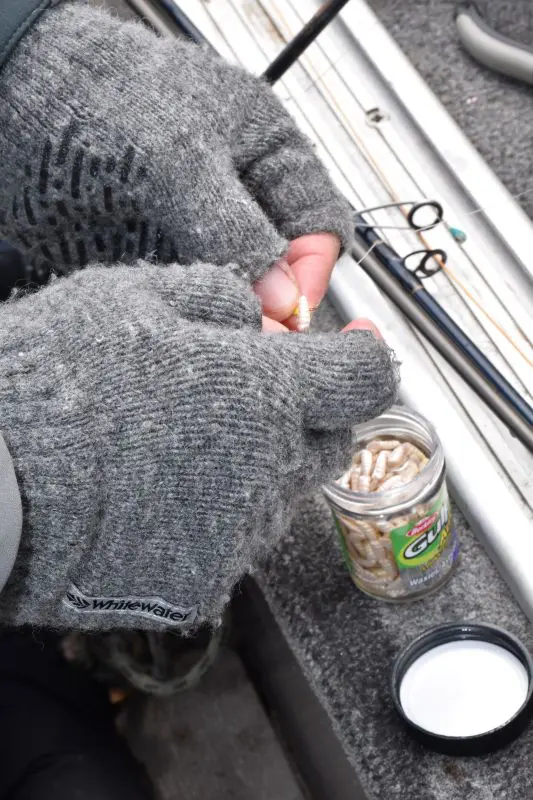
- Fingerless wool gloves come in handy when the waters are still chilly in the spring.
The perch spawn is short and sweet. One day you’re catching jumbos, and a week later they’re gone. Where they go is anyone’s guess. If many of the females show signs of being spawned out, and you start catching only aggressive, dinky males, the spawn is winding down, and it’s time to shift your attention to crappies.
Crappies, like perch, are broadcast spawners, so they don’t technically make beds, but they tend to hang in a given area after spawning. During the pre-spawn, specks will cluster near docks, trees, laydowns, boat houses, and pilings. Specks will often suspend just under the surface to soak up spring sunshine. Tightly schooled, they can be ultra-spooky and challenging to approach. Polarized glasses can help spot the suspended specks. Crappies start thinking about spawning when the temperature reaches 50 degrees in the North Country, but the actual spawn probably doesn’t begin until it tops 60 degrees.
Plastics excel for crappies. You can fish them under a float, pitch them, or swim and twitch them. Gulp! Minnows rock for specks. Try the one-inch models in white, chartreuse, or the natural two-toned colors.
Post-spawn crappies will hang out in the shallows long after the spawn, and there’s an overlap between when the specks leave and the bluegills begin moving in. Smorgasbord catches are possible then.
How long the bluegill spawn lasts depend on the weather. If we have a spring where it goes from chilly to hot in a matter of days, the spawn will be short and sweet. Ideally, we have a gradual warm-up, and the spawn lasts into June.
Last spring was one of those years. It got warm towards the end of April and early May. It’s typically early May before the red-breasted bulls begin moving into the shallows to set up shop in the Upper Midwest. They build nests and wait for the females to arrive.
Last year it got warm, and the bull ‘gills headed shallow, but a cold spell pushed them back to deeper water. The scenario repeated several times in May, extending the spring panfish fishing calendar.
Friend Doug Veldhuizen joined me in mid-May to sample the bluegill fishing. We headed for a cove where the bluegills had started to bed and where I’d caught 50 hand-sized slabs the week before. After probing the shallows for a bit, we realized the ‘gills had moved deeper after several cold days, we’d experienced early that week. We moved to the weed edge in deeper water, stretched out our slip bobbers, and were instantly into fish.
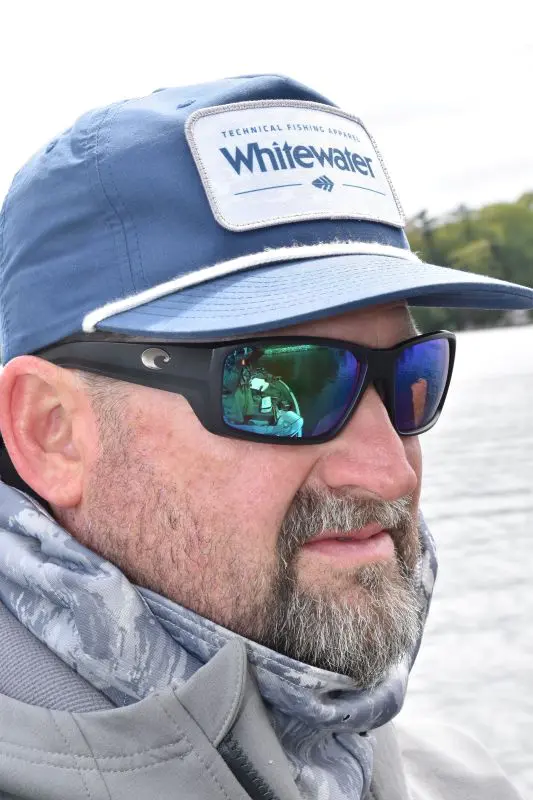
- Doug Veldhuizen sporting his Whitewater apparel.
I took a break to sip coffee while Doug continued to haul in slab bluegill after bluegill. Then, I watched as he lost a half dozen in a row. Something wasn’t right. I told him to swing his line over to me and discovered the problem. The jig head had slid down the shank of the hook and was lodged on the bend of the hook, making hooking them impossible. As soon as we changed jigs and Doug added another Gulp! waxworm to the hook, he went right back to catching bulls. It wasn’t long before we had a fish basket full of bluegills.
The weather can be fickle in May. I usually don’t need my clunky winter boots anymore, but it’s not the time for flip-flops either. A good compromise is Whitewater’s new Basin Deck Boot. The Basin Deck Boot prepares you for whatever May throws at you. The easy-on style offers a secure fit and confident footing on slick, wet surfaces. The supportive Polyurethane (PU) insole is highly durable and provides superior cushioning and support from the time you hit the water until you tie up at the dock. The 100% waterproof 3mm neoprene with 2mm air mesh, front and rear webbing pull-on handle, and rubber heel kicker means cold feet will be the last thing you’ll have to worry about.
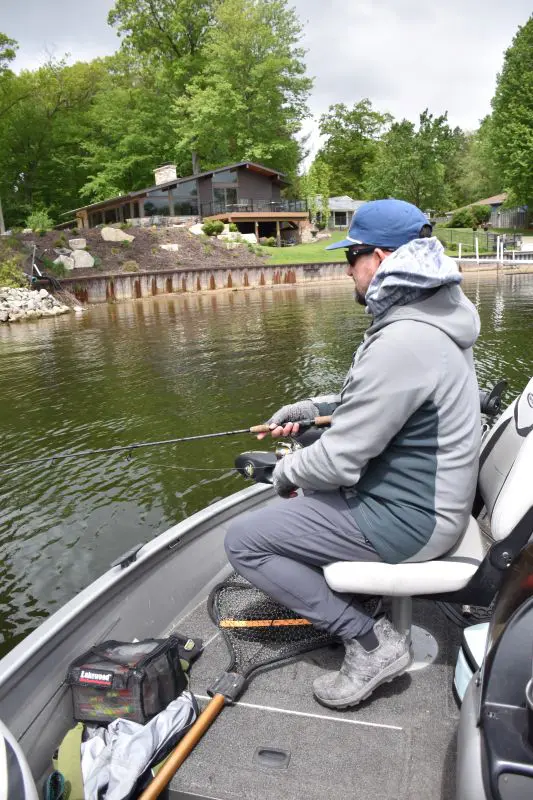
- Bluegills can be found in the shallows or deeper water, depending on the weather.
Another item you’ll want to have along when targeting spring panfish is rain gear. You never know what kind of conditions to expect in May. Afternoon thunderstorms can blow up, or the wind might suddenly freshen, bringing a cool breeze. Either scenario is a good reason to carry a rain suit like Whitewater’s Packable Rain Jacket and Bibs. The Packable Rain Jacket and Bibs’ compact design stows in an included stuff bag, which means you can stow it in a storage compartment, under the seat, or in a backpack for quick and easy access. You’ll never get caught unprepared. Fully taped seams, adjustable Velcro closures, and premium waterproof zippers allow you to batten down the hatches if you need to.
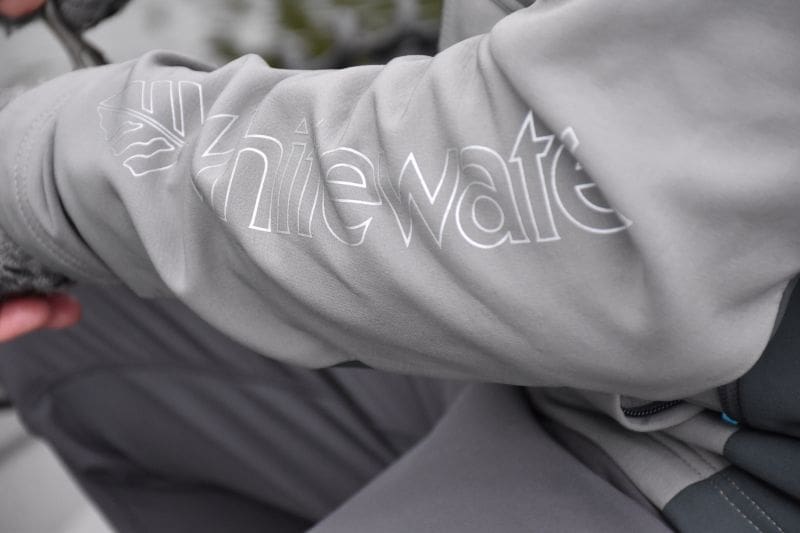
- Quality apparel can keep you comfortable while fishing in early spring.
The spring panfish spawn is a guarantee. But if you wait until the actual spawn is taking place, you’ve already missed out on a bunch of great fishing.